The Gap Between Deciding and Becoming
On Integration Lag — and how to stop mistaking an old reflex for your final identity.

You decide things will be different now.
You will stop arranging your life around everyone else’s timing. You will protect the hours you need for your own work. You will stop saying yes when you mean no. You will finally do the difficult thing you have postponed for months.
The decision feels real. For a moment, you can see the person you are about to become.
Then an ordinary day begins.
Someone says they will be there soon, so you wait. Their timing slips, but instead of getting on with your own plans, you keep adjusting. By the time they arrive, your day has moved around them again. You are irritated, partly with them, but mostly with yourself because you have seen this pattern before.
Or perhaps the moment is social. You have spent days thinking about the boundary you need to set. In private, your reasoning is clear. You know what happened, what you will no longer accept and exactly what you want to say. Then the person is in front of you. Your body tightens. The words come out softer than intended. You explain too much, ask for less than you need and leave wondering why all that clarity disappeared when it mattered.
This is where people begin to doubt themselves.
They assume the decision was false because the behaviour did not immediately change. They think the old response returning means they are still the same person.
I call this gap Integration Lag.
It is the delay between understanding something and becoming able to live it. Your mind has reached a conclusion that your habits, relationships and automatic responses have not caught up with yet.
Most people experience this gap as evidence of failure. It is often the first real evidence that change has started.
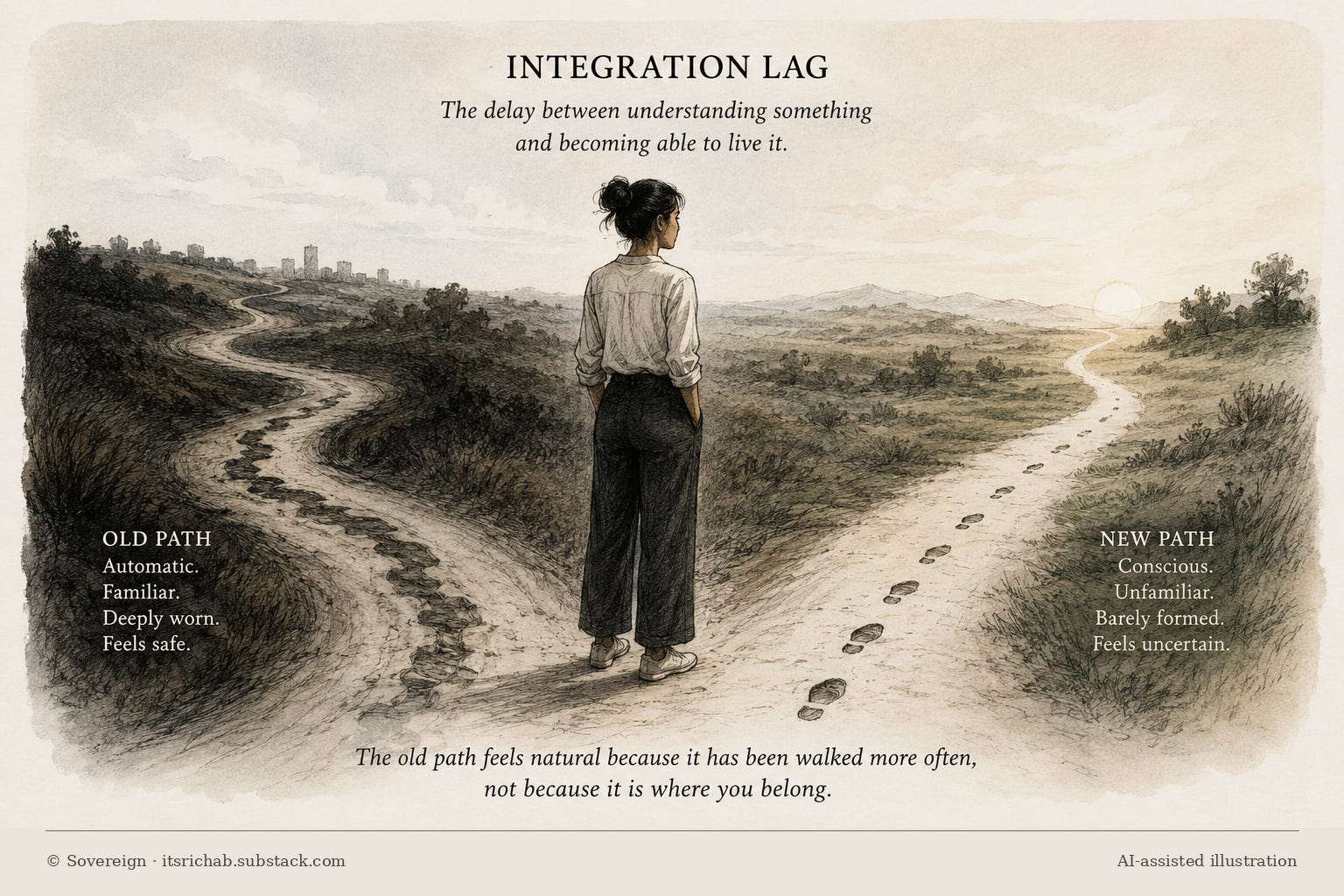
Your insight arrived before your reflexes changed
A habit is not only something you do regularly. It is a response you have rehearsed until it begins making decisions before you consciously enter the room.
Maybe you learned to keep the peace by being flexible. Maybe you became reliable by treating your own plans as the easiest ones to move. Maybe you learned that being liked required being agreeable, available and easy to accommodate.
These behaviours can become so normal that they stop looking like behaviours. They start looking like personality.
“I am just patient.”
“I am easy-going.”
“I work better under pressure.”
“I do not mind.”
Then one day, you notice the cost. Your patience is resentment with good manners. Your flexibility means your life is permanently built around other people. Your ability to work under pressure is the result of avoiding anything that makes you feel exposed. “I do not mind” has become the sentence you use before doing something you absolutely mind.
That realisation matters, but it does not uninstall the pattern.
The old response still knows the route. It has years of practice. The new one may be intellectually convincing, but it has barely been rehearsed.
This is why change can feel humiliating at first. You know better, yet you still watch yourself repeat the behaviour. Before, the pattern ran without your awareness. Now, you are conscious enough to witness it but not always practised enough to interrupt it.
Awareness develops faster than skill. You can see the gap before you know how to close it.
Change has to happen where the old version of you appears
We often prepare for change in private.
We write down what we will say. We imagine the new routine. We promise ourselves that next time will be different. In our own heads, we are clear, calm and decisive.
The problem is that most habits were not formed in isolation. They were formed in specific conditions.
The boundary disappears when someone is disappointed.
The discipline disappears when the work becomes difficult enough to expose you.
The commitment to yourself disappears when another person’s needs enter the room.
So the new response has to be practised under those same conditions. You cannot become someone with boundaries only while nobody is testing them. You cannot become more self-directed while continuing to organise every day around other people’s convenience. You cannot become visible while avoiding every situation in which you might be judged.
The new version of you has to be practised in the situations where the old version usually takes over.
This is why change can feel like exposure. You return to the exact type of moment where the old pattern usually takes control and try something slightly different.
Not something impressive. Something usable.
Instead of waiting indefinitely, you continue with your own plan.
Instead of saying yes immediately, you say you will think about it.
Instead of delivering the perfect boundary, you say one honest sentence and resist the urge to bury it under five minutes of explanation.
You will feel the resistance. That is almost guaranteed. The old behaviour created familiarity, and familiarity can feel safer than a healthier response you have never properly tested.
There is no clever way to skip this part. You have to experience the discomfort of behaving differently while the old instinct is still fully available.
Stop using one bad moment as a character reference
The first attempts will often be clumsy.
You may hold the boundary, then spend the rest of the evening wondering whether you were too harsh. You may choose your own priorities, then feel guilty for not being as available as usual. You may begin the work, avoid it again the next day and immediately decide that you lack discipline.
This is where many people turn one imperfect moment into a verdict about who they are.
They do not simply say, “I repeated the old habit today.”
They say, “I never change.”
That sentence gives one bad moment far too much authority.
A lapse tells you where the old pattern is still strong. It may reveal the trigger, the person, the emotion or the environment that pulls you back into it. That information is useful. Shame usually is not.
Instead of asking whether you performed the change perfectly, look at what shifted. Perhaps you noticed the pattern sooner or created a pause that did not exist before. Perhaps you recovered faster, even if the old response still won.
These changes are easy to dismiss because they do not look dramatic. But the pause that did not exist before matters. The resentment you can now trace back to self-abandonment matters. The moment you catch yourself waiting for someone else to begin your own day matters.
Change often enters quietly. First as awareness, then irritation, then a pause, then an imperfect choice. Only later does it start looking like a new identity.
Plan for the version of you who will want the old life back
Most plans for change are made by the inspired version of us.
That version is clear about everything. It knows what matters, understands the pattern and feels completely ready to behave differently.
Unfortunately, that version is rarely in charge when the difficult moment arrives.
The person making the actual decision may be tired, anxious, guilty, rushed or desperate to avoid conflict. That person needs more than a beautiful intention.
They need a plan.
A real plan identifies the moment where the old behaviour usually begins. It gives you a response before your reflex starts negotiating.
When you feel pressure to agree, what sentence will buy you time? When avoidance appears, what is the smallest action that keeps you connected to the work?
The same applies to the ordinary situations that quietly consume your day. Someone says they will arrive in ten minutes, but half an hour passes. Instead of remaining suspended in their delay, you continue with the task, errand or plan you would have started if they had never called.
This is where wanting becomes practice.
You just need to recognise the few moments where the old version of you repeatedly wins and prepare for them with unusual honesty.
Change is rarely lost in a dramatic decision. It is usually lost in the ordinary moment where you tell yourself it does not matter this once.
The new self is built before it feels natural
There is a period where the old identity no longer fully fits, but the new one still feels like something you are performing.
You may understand that your time matters and still feel selfish when you protect it. You may know that a boundary is reasonable and still feel physically uncomfortable saying it. You may be committed to a goal and still feel the familiar urge to postpone it.
The new behaviour simply feels unfamiliar at first.
People often wait for the feeling of certainty before behaving differently. But certainty usually comes later, after you have survived enough repetitions to trust yourself.
You protect your time and discover that the world continues.
You let someone be disappointed and realise the relationship does not immediately collapse.
You begin before you feel ready and learn that discomfort does not prevent you from functioning.
These moments accumulate. Eventually, you stop needing to convince yourself quite so much. What once required a full internal debate becomes a simpler decision.
That is how Integration Lag closes.
Your life begins reflecting what you already understood. The new choice gathers enough evidence to feel like something you do, then something you trust, then something you are.
Until that happens, resistance will keep trying to impersonate truth.
It will tell you that the discomfort means you are making the wrong choice. It will use one lapse to argue that nothing has changed. It will point to the old impulse and insist that this is who you really are.
Do not let a well-rehearsed reflex write your identity.
The old version of you is simply faster because it has had more practice. The only way the new version catches up is by being chosen in real situations, especially when that choice feels awkward, inconvenient or slightly unlike you.
You changed your mind first.
Now your life needs time, planning and repetition to believe you.
Cheers,
R.B.
I truly enjoyed this read. I think it really puts words to a lot of things I've been unable to describe on this journey of change, becoming someone new, retiring the old version and habits.
It's actually the first time I came across the term 'integration lag' - I am bookmarking this post and going to save it for future reference because it really opened my perspective on many aspects of my life. Thank you so much for this powerful insight!
I see myself in these words in so many ways. A few years ago, I was much more confident and had much clearer boundaries. That version of me allowed me to reach a level of peace I had never experienced before. Then, for various reasons, that version of me fell apart. Now I’m trying to rebuild her, and articles like this are helping me do that. Thank you!